
Native oyster reefs once covered 20% to 30% of the North Sea. Today they functionally extinct with only a few patches left. Oyster Heaven's Native Oyster restoration projects aim to bring them back, and Exo Environmental has helped to support their work in the UK since 2024.
Oyster Heaven use novel “Mother Reef” technology: artificial clay substrates which provide a scaffold for the juvenile oysters to settle upon and form the basis of the restored reef. Over time, natural settlement of the oysters’ offspring will take over, and the reefs become self-sustaining. Here at Exo, we supported site selection and licensing, carried out site surveys, and designed and monitored the project's initial pilot-scale Mother Reef deployments between 2024 and 2026. The pilots ran at two subtidal sites which had been selected for a full-scale Mother Reef deployment, off the North Norfolk coast and in the Wash. Results showed the native oysters growing well at these sites, and that the Mother Reefs can support a wide range of marine life. Its findings are now shaping the full-scale reefs licensed at both sites.
Project Details
Client - Oyster Heaven
Project - Native Oyster Restoration Project
Locations - Norfolk Seaweed Farm, off the North Norfolk coast, and the Wash
Pilot period - June 2024 to September 2026
Local partner - Norfolk Seaweed
Exo's role - Site selection, surveys and feasibility, licensing support, pilot monitoring, and ongoing reef monitoring
Methods - Oyster counts and measurements, species surveys, eDNA, temperature and light logging, and water quality testing
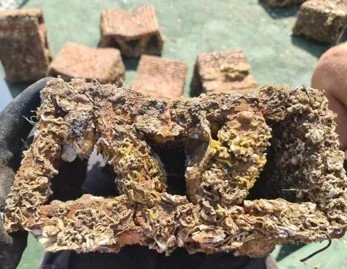
A Mother Reef brick after two years on the seabed off the North Norfolk coast, August 2026.
Why Native Oysters Matter
The native European flat oyster (Ostrea edulis) is a reef builder. Its reefs filter seawater, create complex habitat for other marine life, provide food for wildlife and people, and help protect coastlines from erosion, tidal surges, and storms.
Over the last century, these reefs almost disappeared. Habitat loss through the historic use of destructive mechanical dredging and overharvesting did most of the damage. Alongside this devastating parasitic disease outbreaks, predators, and then later on the competition from the non-native Pacific oyster added to the pressure.[FT1] By the mid-20th century, native oyster reefs were described as ecologically extinct.
The Wash shows what was lost. Photographs from around 1900 and maps from the late 19th century show native oyster beds covering roughly 30km². Both are held in the archives of the True's Yard Fisherfolk Museum in King's Lynn. Those beds are now gone.[FT2] A recent study from Essex Research Repository also provides historic evidence of The Wash’s oyster beds, “Records reveal the vast historical extent of European oyster reef ecosystems”.
Oyster Heaven aims to bring them back at scale. Its patented Mother Reef is a clay brick that is seeded with juvenile oysters at a hatchery, then placed on the seabed to become the foundation of a new reef. Over time the clay breaks down, leaving a living reef behind.
Testing The Approach: The Pilot
Before building reefs of millions of oysters, Oyster Heaven tested its Mother Reefs at five pilot locations along the North Norfolk coast and in the Wash. Three were harbour and intertidal sites near Wells-next-the-Sea and Blakeney. This case study focuses on the two subtidal sites, both chosen as locations for full-scale reefs.
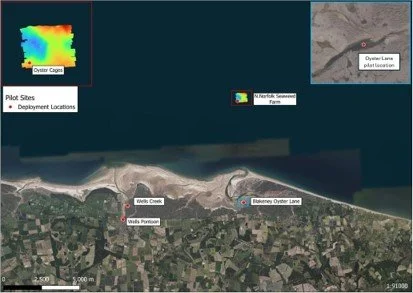
The North Norfolk pilot locations, with Norfolk Seaweed Farm offshore. The fifth pilot site was in the Wash.
Two Sites, Two Settings
Norfolk Seaweed Farm. About 12.5m below chart datum, on coarse sand, pebbles, gravel, and cobble beneath Norfolk Seaweed's farm. Two cages holding 36 Mother Reef bricks were deployed at the site in June 2024.
The Wash. About 25m below chart datum, within part of the location of the historic oyster beds, on a site chosen for its seabed and because it is largely free from the use of fishing techniques that would hamper the reef’s development. Two cages holding 52 bricks were placed about 500m apart in October 2024, marking the northern and southern edges of the planned reef.
Each brick was seeded with juvenile native oysters at a certified Bonamia-free UK hatchery and kept in nursery tanks for at least two weeks. This protects the oysters through the stage of life when losses in the wild are highest. The bricks were then deployed at the site inside metal cages on the seabed, so they could be lifted, checked, and returned.
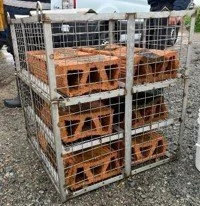
Mother Reef bricks loaded into a pilot cage, ready for deployment.
Exo's Role
Site surveys and feasibility, to understand the seabed and confirm suitable locations.
Licensing support, including shadow Habitats Regulations Assessments for the marine licence applications.
Pilot monitoring, following the European Native Oyster Habitat Restoration Monitoring Handbook from the Native Oyster Restoration Alliance (NORA), so the results can be compared with Oyster Heaven's projects elsewhere.
How We Monitored
Across the monitoring visits, our team recovered the cages to the vessel and:
counted every live oyster on every face of each brick surveyed, including inside its hollow voids
measured shell height and length to the nearest millimetre
recorded the other species living on and around the bricks, photographing each one for identification
scraped samples from the bricks for environmental DNA (eDNA) analysis, which picks up species too small or too similar to identify by eye
downloaded data from a temperature and light logger fitted to the cages, which recorded conditions every 15 minutes
measured water quality at the seabed with a multiparameter sonde, including temperature, pH, dissolved oxygen, salinity, turbidity, and chlorophyll
What The Monitoring Showed
After around two years on the seabed, the pilot gave a clear answer: native oysters can grow well at both sites, and the Mother Reefs quickly become home to a wide range of other marine life.
Strong, Healthy Growth
The oysters grew fast. At Norfolk Seaweed Farm, they went from an average of 6.6mm on deployment to 57.5mm after 26 months, with the largest reaching 82mm. In the Wash, they grew from an average of 13mm to 53.9mm in 23 months, with the largest reaching 89mm.
These sizes are in line with published studies of native oysters grown in cages in the North Sea. Growth slowed in the second year, which is normal as oysters approach the age at which they can breed.
In the Wash, the bricks still carried an average of 34 live oysters each after nearly two years. Most of the oysters alive at the December 2025 check were still alive nine months later.
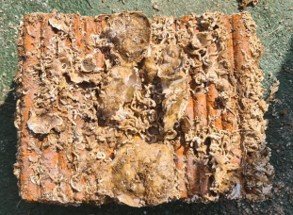
Healthy native oysters on a Mother Reef brick at Norfolk Seaweed Farm, August 2026.
A Reef In The Making
The bricks were colonised by sponges, tubeworms, sea squirts, bryozoans, hydroids, and anemones, the early settlers that make a hard surface into living habitat. At Norfolk Seaweed Farm, our visual survey recorded 28 additional species. eDNA then detected 50 groups of organisms, most of them either missed by eye or too similar to tell apart without DNA. In the Wash, we recorded 25 additional species on the bricks visually, and an additional 24 species through eDNA analysis.
Larger animals moved in too:
Brown crabs, a commercially important species, were found sheltering inside every Mother Reef brick we surveyed in the Wash.
Long-spined sea scorpions had laid their eggs on Mother Reef bricks at Norfolk Seaweed Farm, a sign the reefs are already supporting new generations of local wildlife.
Velvet swimming crabs, squat lobsters, spider crabs, and shore rockling were recorded on and around the bricks.
Ross worm (Sabellaria spinulosa) settled at both sites. It builds reefs of its own, which are protected as a Priority Habitat.
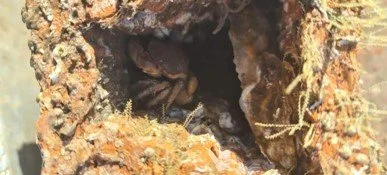
A juvenile brown crab using a Mother Reef brick for shelter in the Wash.
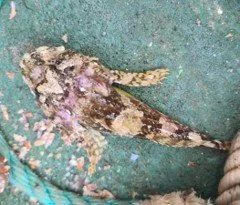
A long-spined sea scorpion, one of two fish species recorded at Norfolk Seaweed Farm.
The Right Conditions
Water quality at the seabed was within the optimal range for native oysters at both sites, including pH, dissolved oxygen, and salinity. Invasive non-native species stayed minimal, limited to small numbers of species already widespread around UK coasts, and they will continue to be monitored.
What The Pilot Taught Us
A pilot exists to find out what works before scaling up. Around two years of work offshore gave the project practical lessons it could not have learned any other way. Each one is now informing the next phase. This pilot has validated the feasibility work for site suitability and that the data derived from the monitoring is setting the foundations of the data set before the large scale project is started
Looking After Oysters Before They Reach The Seabed
In early summer 2024, bad weather held the Norfolk cages in Wells Harbour for about two and a half weeks before they could be taken out to Norfolk Seaweed Farm. Our temperature logger helps explain why the oysters on the top shelf fared worst during that wait: midday low tides on warm days pushed temperatures at the cage above 30°C. That is valuable knowledge for planning how juvenile oysters are held while waiting for a weather window.
Better Cages For Monitoring
At Norfolk Seaweed Farm, oysters on the middle and top shelves did better than those on the bottom shelf. A likely reason is the weight of the cage pressing the lowest bricks into the softer clay beneath the gravel. Bricks laid straight onto the seabed in the full-scale reef will not carry that extra weight.
The pilot has already led to better equipment. Bricks from the top two shelves of the Norfolk cage are back on the seabed in a newly designed stainless steel cage. It is smaller and lighter, with feet that lift it off the seabed and sacrificial anodes to help prevent corrosion. In the Wash, the southern cage was replaced in December 2025 with an improved design that is more stable and less likely to be damaged by corrosion or during recovery. The cages in its new form could be used for monitoring of the large-scale project. Proxy cages are a common practice for easy access reef monitoring, and in sites at these depths, it is an accessible method to retrieve, monitor and re-deploy reef elements, without needing divers.
Maybe add that this pilot has validated the feasibility work for site suitability and that the data derived from the monitoring is setting the foundations of the data set before the large scale project is started, as it already gives information on oyster survival and growth as well as species recruitment.
You could add here that the cages in its new form could be used for monitoring of the large scale project. Proxy cages are a common practice for easy access reef monitoring, and in sites at these depths, it is an accessible method to retrieve, monitor and re-deploy reef elements, without needing divers.
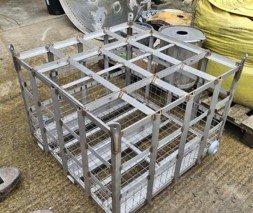
One of the newly designed monitoring cages, now in use at Norfolk Seaweed Farm.
Finding & Recovering Cages At Sea
Storms and winter weather detached several surface marker buoys during the pilot. In the Wash, side-scan sonar on board the vessel confirmed that the northern cage had stayed exactly where it was placed, aiding in its retrieval by other methods. The project also tested acoustic releases, which let a cage be recovered without any surface buoy. The trials showed that the mooring layout needs careful consideration so that these systems can be relied upon for long-term monitoring.
Two Survey Methods Are Better Than One
The visual survey and eDNA each picked up species the other missed. Using both gives the fullest picture of the life on the reefs, so we recommended keeping both in future monitoring.
From Pilot To Full-Scale Reefs
The pilot did its job. It confirmed that the physical, environmental, and biological conditions at both sites can support native oysters, and it gave the project the evidence it needed to move forward.
Marine licences for full-scale native oyster reef restoration have now been obtained at both sites. Oyster Heaven is working with Norfolk Seaweed under the joint venture, the Norfolk Oyster Company. At Norfolk Seaweed Farm they plan to deploy at least 4 million native oysters on Mother Reefs by the end of 2027. Once complete, it will be one of the largest native oyster reef restoration projects in the UK. In the Wash, the new marine licence opens the way for full-scale restoration on part of the historic oyster beds.
The next phase builds directly on the pilot:
Monitoring cages alongside the reefs. Monitoring cages of the improved designs will sit alongside the full-scale reefs, so the growth and health of the oysters can be tracked year after year.
More reliable recovery. The mooring set-up will be redesigned using valuable learnings from the acoustic release trials.
Completing the pilot picture. We have recommended continued monitoring of the pilot cages at each site, to add further data on oyster survival and growth across both reef areas.
Ongoing monitoring by Exo. In collaboration with Oyster Heaven and their partners, our team will continue monitoring as the reefs are built, using consistent methods so each year's results can be compared with the last.
Looking Ahead
Bringing back a habitat that has been missing from the North Sea for most of a century takes patience, careful science, and partners willing to learn as they go. This pilot showed what native oysters can do when they are given a head start: grow strongly, attract crustaceans, fish, and reef-building worms, and lay the foundations for something much bigger.
We are proud to have supported Oyster Heaven from the first seabed surveys through to the full-scale reefs, and we look forward to watching them grow.